
PART 3
I closed my eyes.
The room seemed to tilt.
They had already prepared the lie.
Not after.
Before.
They had discussed what they would say while I was still lying on the shed floor.
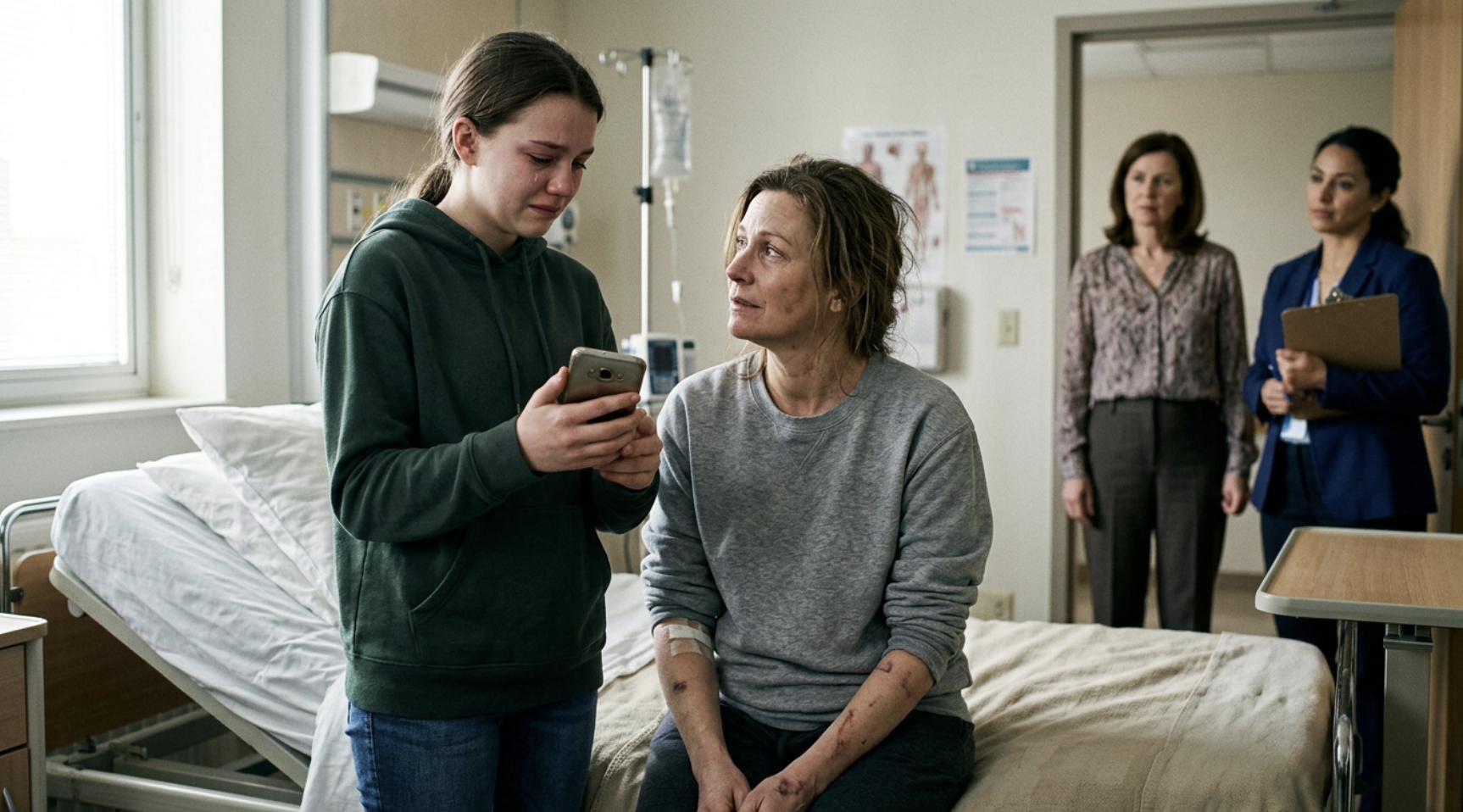
My sister reached over and took the phone from my hand.
“There’s more.”
I shook my head.
“I don’t want to hear it.” “Yes,” she said gently. “You do.”
I opened my eyes.
She turned the volume up.
The recording crackled.
My mother-in-law laughed.
“If she goes to the police, who’s going to believe her? She’s been in that house for years. People will think she’s trying to destroy the family.”
My husband answered, “She won’t go.”
“How do you know?”
“Because she never does.”
Those five words hurt more than I expected.
Because he was right.
For years, I had stayed silent.
Not because I didn’t know what was happening.
Because I believed silence could protect my children.
I thought if I endured one more argument, one more insult, one more frightening night, maybe the children would grow up and leave the house safely.
I thought keeping the family together was the same thing as protecting the family.
But sitting in that hospital bed, listening to my husband confidently explain why I would never speak, I realized something.
My silence had not protected anyone.
It had taught him that there would never be consequences.
My sister leaned closer.
“There’s another part.”
I looked at her.
“What?”
She hesitated.
“Your daughter recorded something from earlier.”
I turned toward my youngest.
She was crying now.
“You knew?”
She wiped her cheeks quickly.
“I didn’t know if it would help.”
“It helped,” my sister said.
My daughter finally looked at me.
“I was scared.”
I reached for her hand.
“So was I.”
Her fingers closed around mine.
“But you still did it.”
She nodded.
That was when the nurse returned.
She looked at my sister, then at my daughter, then at me.
“Your doctor wants to speak with you.”
My sister stood immediately. “Is my sister being discharged?”
The nurse shook her head.
“No. She’s staying.”
I felt something inside me loosen.
Staying meant I did not have to return home.
Not tonight.
Maybe not tomorrow.
Maybe not ever.
The doctor came in a few minutes later with a social worker.
The social worker sat beside my bed and introduced herself.
She did not ask why I stayed.
She did not ask why I didn’t leave sooner.
She did not say, “Why didn’t you tell someone?” Instead, she asked one question.
“Do you feel safe going back to your home?”
I stared at the blanket.
“No.”
The word came out almost soundlessly.
But once it was spoken, it could not be taken back.
“No,” I repeated.
My sister squeezed my shoulder.
The social worker nodded.
“Then we will work from there.”
For the first time in years, someone did not ask me to explain why I deserved safety.
They simply started helping me find it.
That night, my husband called.
His name appeared on the hospital phone.
My entire body stiffened.
My sister reached for the phone.
“Don’t answer.” I stared at the screen.
It stopped.
Then it rang again.
And again.
Then a message appeared.
We need to talk. You are making this much bigger than it is.
My sister read it.
She looked at me. “Do you want to respond?” I shook my head.
Another message arrived.
Your mother is extremely upset.
Then:
Think about the children before you destroy this family.
I stared at those words.
The same man who had tied my hands to a wooden beam was now using the children as a weapon.
My sister took a screenshot.
“Keep everything.”
She created a folder on her phone.
“Messages. Calls. Photos. Medical records. Everything.”
I nodded.
Then another message arrived.
This one was different.
If you tell anyone what happened, you’ll regret it.
My sister’s expression hardened.
“That one stays.”
The social worker saw it.
She immediately documented it.
And suddenly, something changed.
The story wasn’t just my word against his anymore.
There was a recording.
There were medical findings.
There were photographs.
There were messages.
And there was my daughter.
A child who had been forced to become a witness because the adults around her had failed to protect her.
I looked at her.
“I am sorry.”
She shook her head.
“Don’t say sorry.”
“What should I say?”
She swallowed.
“Say we’re not going back.” My heart broke.
But this time, not from fear.
From determination.
“We’re not going back.”
The next morning, detectives came to the hospital.
I expected them to be cold.
Instead, the woman who spoke with me pulled a chair close to the bed.
She explained that I could stop at any time.
She asked whether I wanted my sister present.
“Yes.”
Whether I wanted my daughter present.
“No.”
She nodded.
“Then she doesn’t need to hear this.”
I almost cried.
It was such a simple sentence.
Yet nobody in my house had ever respected a boundary so easily.
The detective listened.
She wrote things down.
She asked about the shed.
The rope.
My husband’s actions.
My mother-in-law’s presence.
The previous injuries.
The threats.
The recording.
When I finished, she closed her notebook. “Your daughter did something very important.”
I looked down.
“She was scared.”
“She was brave.”
I shook my head.
“She shouldn’t have needed to be brave.”
The detective’s expression softened.
“No. She shouldn’t have.”
That sentence stayed with me.
Because it was the first time someone had said exactly what I had been unable to admit.
My daughter should have been worried about homework.
Friends.
Music.
School.
Not about secretly recording violence in a shed.
Not about learning which footsteps meant danger.
Not about deciding which adult could be trusted.
I realized then that leaving wasn’t only about saving myself.
It was about giving my children back the childhood I had watched disappear.
By afternoon, my husband arrived at the hospital.
Security stopped him at the entrance.
He argued.
He demanded to see me.
He told them he was my husband.
Then my mother-in-law arrived.
She made even more noise.
“This is a family matter!”
A security guard calmly told her she could not enter without authorization.
My husband shouted my name from the hallway.
I heard him from my room.
For years, that voice had controlled the temperature of the entire house.
One shout could make everyone stop eating.
One slammed door could send the children into their rooms.
One angry sentence could ruin an entire weekend.
But now?
He was on the other side of a locked hospital door.
And I was not alone.
My sister stood beside me.
The social worker stood nearby.
A nurse was at the doorway.
And for the first time, his anger had nowhere to land.
Then I heard him say something I never expected.
“She belongs to me!” My sister looked at me.
I looked back.
And something inside me finally died.
Not my courage.
Not my hope.
The belief that I owed him anything.
The nurse closed the door.
The shouting faded.
And I whispered,
“No.”
My sister heard me.
“What?”
I looked toward the door.
“She doesn’t.”
My sister smiled through her tears.
“No.”
She corrected me gently.
“She belongs to herself.”
I closed my eyes.
And for the first time in years, I believed it.
Three days later, the hospital released me to a temporary safe location arranged through my sister.
I walked out wearing borrowed clothes.
Everything I owned was still in that house.
My photographs.
My winter coat.
My wedding album.
My children’s old drawings.
The kitchen table where we had eaten thousands of meals.
The bedroom where I had cried silently so nobody would hear.
For a moment, I felt like I was leaving my entire life behind.
Then my daughter took my hand.
“Mom?”
“Yes?”
“Are you sad?”
I looked at the hospital doors behind us.
“Yes.”
She nodded.
“Me too.”
Then she squeezed my hand.
“But we’re free.” I stopped walking.
Free.
The word felt unfamiliar.
Almost frightening.
But beautiful.
I hugged her.
And for the first time, I allowed myself to cry without apologizing for it.
We kept walking.
Neither of us looked back.
Not yet.
Because there was still one thing left inside that house.
The truth.
And soon, my husband was going to discover that the woman he believed would never speak had finally found her voice.
NEXT PART IS HERE
